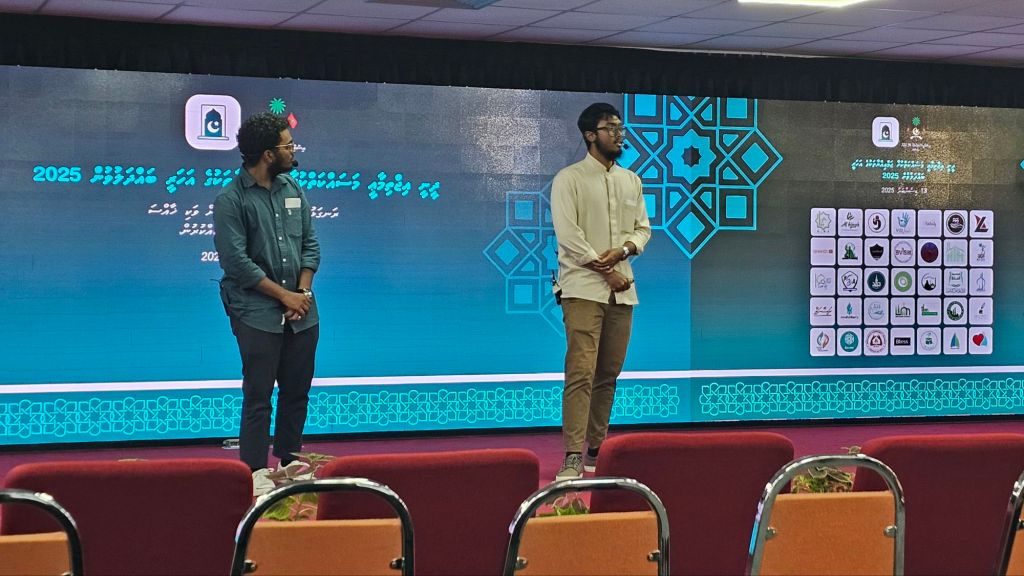
Today, I had the opportunity to listen to a presentation by the youth-led NGO Youth Union, delivered by Muhannadh, their Events Coordinator, and Abdul Rahman, their Secretary General. At the Annual Conference of Religous and Social NGOs, organised by the Ministry of Islamic Affairs.
I want to say this upfront: there was no exaggeration in what they shared. What I heard was grounded in lived experience, observation, and sincere concern for the spiritual and emotional wellbeing of our young people.
Meeting Youth Where They Are
One of the strongest messages from the presentation was this: young people cannot be reached simply by calling them to come and listen.
“If we want to reach young people, we have to go where they already are – not where we wish they were.”
Youth Union’s monthly gatherings are built around this understanding. Food, discussions, debates, and laughter bring young people together. But what makes these gatherings different is the intention behind them. Every activity is kept within Islamic boundaries, and every event includes a moment – sometimes brief, sometimes longer – to remember Allah.
A Sheikh is invited to every gathering. Not as an untouchable authority figure, but as someone who sits with the youth, laughs with them, and offers advice. Even a five-minute reminder or a short dhikr changes the tone of the space. It reminds young people that joy and remembrance are not opposites.
Halal Fun Is Still Fun
Muhannadh spoke about something we rarely acknowledge openly: young people want to have fun – and that is not haram.
Youth Union organizes futsal tournaments, picnics, PlayStation competitions, and even wrestling inspired by the Sunnah, known as King of the Ring. Before any activity begins, a short religious reminder is shared.
What struck me most was this example: during a PlayStation tournament, when the adhan is heard nearby, everything stops. The game is paused. No final round. No exceptions. Everyone is asked to go for prayer and return afterward.
“Islam doesn’t stop us from enjoying life. It teaches us what to prioritise while enjoying it.”
That single act teaches more than many long lectures ever could.
Creating Safe Spaces for Girls to Lead
Abdul Rahman highlighted Youth Union’s work with young women – an area that deserves far more attention. Programs such as Demia, Becoming Her, She Before We, and Queen of the Kitchen are designed specifically for girls, addressing both faith and real-world challenges.
What makes these initiatives stand out is that they are entirely led by the girls themselves. Planning, organising, marketing, coverage – everything. Female scholars are invited to speak, advise, and engage, creating safe and empowering spaces without mixed-gender pressure.
This is leadership development in its truest form: responsibility, trust, and ownership.
Learning From Observation, Not Assumption
Another important lesson shared was about Setting a Goal, an initiative that has been running since 2016 and is now organised with UN and Hijra partners during Ramadan.
Youth Union observed that young people do not gather much in the evenings during Ramadan. Instead of blaming youth or insisting on the same format, they adapted. For Ramadan 2026, they plan to move the event to night-time – aligning their work with actual youth behaviour.
This is what listening looks like.
Weak Foundations and the Power of Reflection
One of the most concerning observations shared was the weak religious foundation among students. Higher secondary students unable to explain the meaning of the Shahada. Young people unsure whether certain practices are obligatory or optional. This confusion is not their fault – it reflects how religion is often taught.
To address this, Youth Union incorporates reflection into their programs. At the end of Setia Goal, they run a simple activity called Game Over, giving participants five to ten minutes to reflect on their lives. Some become emotional. Some rethink their direction.
Sometimes, a pause is enough to awaken the heart.
Bridging Youth, Scholars, and Support
Perhaps the most critical role Youth Union plays is serving as a bridge. Young people struggling with depression, suicidal thoughts, or confusion often find it easier to reach out to them than directly to a Sheikh. From there, Youth Union connects them to scholars and professionals – quickly, quietly, and with care.
That bridge saves lives.
A Message We Must Take Seriously
The presentation made one thing very clear: many young people do not see religious spaces as solutions to their problems. Until we change that perception, we will continue to lose them – not to rebellion, but to silence.
Faith is not joyless. Fun is not forbidden. Mosques can be community spaces. Language must be accessible. And perfection should never be a requirement to belong.
I am grateful to Muhannadh and Abdul Rahman, and to the entire Youth Union team, for reminding us of this truth:
When we offer solutions to real problems, faith finds its way back naturally.
Smile let Smile.
 Smile and Let Smile