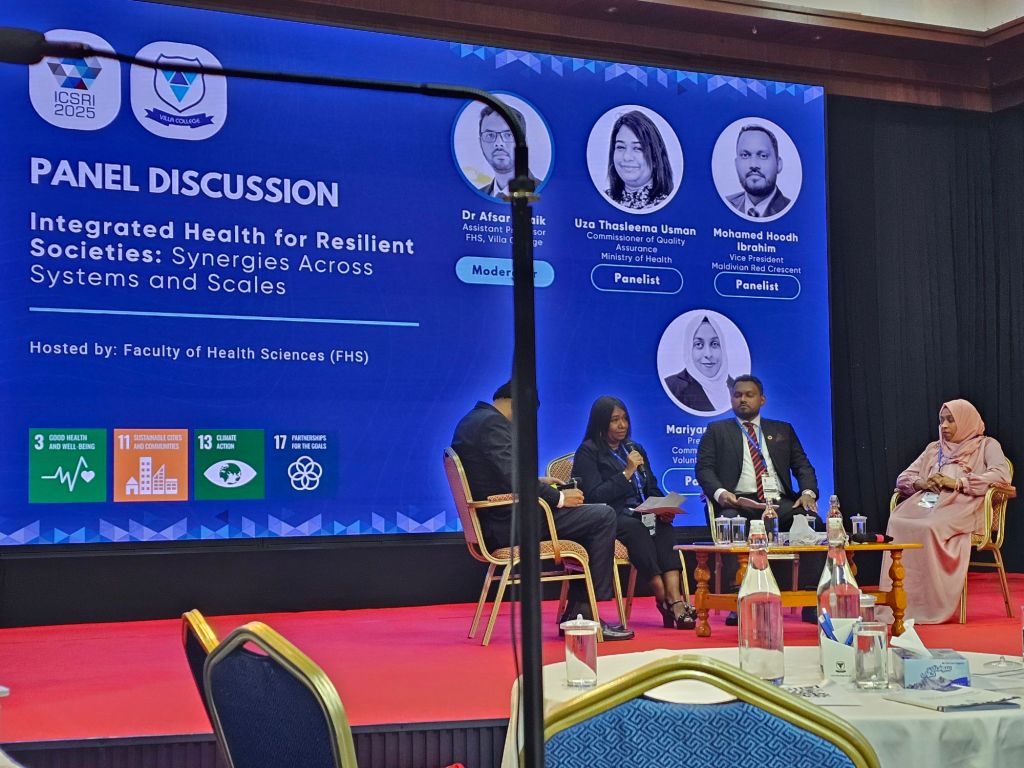
Today, I attended a session at the International Conference on Social Research & Innovation (ICSRI 2025) – the panel discussion on “Integrated Health for Resilient Societies: Synergies Across Systems and Scales”, hosted by the Faculty of Health Sciences, Villa College.
Moderated by Dr. Afsar Shaik, the panel brought together Uza Thasleema Usman (Commissioner of Quality Assurance, Ministry of Health), Mohamed Hoodh Ibrahim (Vice President, Maldivian Red Crescent), and Mariyam Niyan (President, Community Nurse Volunteers NGO).
Panelists highlighted that integrated health is not a new idea but a return to a holistic, patient-centred approach. Uza Thasleema explained that integrated systems are built on quality standards — equity, timeliness, efficiency, and safety — ensuring that patients receive coordinated care across providers. She also called for innovation in telemedicine, outreach services, and “hospital at home” models to reduce waiting times and improve patient satisfaction.
From a humanitarian lens, Mohamed Hoodh stressed the critical role of community mobilisation, recalling the Maldivian Red Crescent’s COVID-19 response that engaged 138,000 volunteers nationwide. He noted that resilience depends on collaboration across government, communities, and civil society, especially as the Maldives faces ageing populations and rising emergencies.
Mariyam Niyan emphasised that community-based care bridges the gap between formal systems and people’s daily realities. She argued that empowering community health workers reduces hospital stays, lowers costs, and tackles the social determinants of health.
The discussion also raised questions on policy change, financing, and traditional medicine. Panelists called on academic institutions to align curricula with integrated care needs and urged policymakers to act on evidence-based research.
The session concluded with a call for “One Health” approaches, linking human, environmental, and animal health to strengthen resilience in the face of future challenges, including climate change.
 Smile and Let Smile